Pricing Information
Pricing Definitions
MSRP: $190,600
Estimated Market Price: Not Available
Invoice: Not Available
Total Cost to Own Not Available
Estimated Payments:
$3,978/month* find current rates
Rebates & Incentives:
No information available
Standard Engine:
5.0L V10, 40 valve, 520 hp @ 8000 rpm
* 6 speed manual (standard) or 6 speed automatic transmission
* 11 mpg city / 17 mpg hwy more info
* Green Rating: 41
Learn about the Green Rating
Avg. User Reviews:
Model Rating:
No reviews yet
Trim Rating:
No reviews yet
My Rating:
write a review
* based on MSRP, 20% down, 6.5% interest rate, 8% sales tax, 48 months.
continued below
Standard Features:
* Front Side Airbags With Head Protection
* All-Wheel Drive
* AM/FM Radio With 4 Speakers Total; 6-Disc CD Changer; MP3 Player
see all features...
Options:
* Rear Electronic Parking Aid With Camera
* Colored Brake Calipers (Gray or Yellow)
* DVD and GPS Navigation Aid
Monday, October 6, 2008

2008 Ferrari 599
2008 Ferrari 599 GTB Fiorano Summary
The 2008 599 GTB Fiorano is a 2-door, 2-passenger luxury sports car, available in two trims, the Coupe and the Coupe F1.Upon introduction, both trims are equipped with a standard 6.0-liter, V12, 620-horsepower engine that achieves 11-mpg in the city and 15-mpg on the highway. A 6-speed manual transmission with overdrive is standard on the Coupe. A 6-speed automatic transmission with overdrive is standard on the Coupe F1.

The 2008 599 GTB Fiorano is all-new for 2008.
Ferrari Info
we're doing a project for school specifically on the "design" of Ferrari cars but we're having trouble finding information on the actual design of the cars, how they are made, etc. If you know of any websites that have this information or just information in general about Ferrari's I would greatly appreciate the links.
search for automotive design.
There are 5 people in a team of automotive designers.
1. Designer of outside of car.
2. Interior designer
3. Marketing and manufacturing
4. Chassis and engine
5. Project leader.
They draw it, then they make a computer drawing on a CAD program. From the computer drawing the machine reads it and carves a clay copy of the car.
After they make the full size version of the car out of clay, they review the design and make some changes by carving the clay themselves.
Then they do the same thing for the inside of the car to work on the design of the ergonomics.
Then they make real versions of it by making the machine carve out the body out of metal.
The engines are hand built.
Everything else is put totheger by machines.
Then they start testing the car and see how they can improve with aerodynamics, handling, engine performance.
search for automotive design.
There are 5 people in a team of automotive designers.
1. Designer of outside of car.
2. Interior designer
3. Marketing and manufacturing
4. Chassis and engine
5. Project leader.
They draw it, then they make a computer drawing on a CAD program. From the computer drawing the machine reads it and carves a clay copy of the car.
After they make the full size version of the car out of clay, they review the design and make some changes by carving the clay themselves.
Then they do the same thing for the inside of the car to work on the design of the ergonomics.
Then they make real versions of it by making the machine carve out the body out of metal.
The engines are hand built.
Everything else is put totheger by machines.
Then they start testing the car and see how they can improve with aerodynamics, handling, engine performance.
Wednesday, September 24, 2008
Caddilac CTS-V Review
No, I didn't get a chance to drive one. Unfortunate for me. I did, however, just read a great review of the CTS-V on About.com:Cars.
Aaron Gold just gushes over the car and it looks like this car will truly be a world beater for GM. What is unfortunate is the timing if the car's release. Hopefully the crappy economy and the retarded price of gas will not hurt the CTS-V too much.
Here is a link to the review:
Aaron Gold just gushes over the car and it looks like this car will truly be a world beater for GM. What is unfortunate is the timing if the car's release. Hopefully the crappy economy and the retarded price of gas will not hurt the CTS-V too much.
Here is a link to the review:
2009 Cadillac CTS-V test drive
Monday, September 22, 2008
September 2008 Dream Car of the Month - Dodge Viper

Dodge Viper Concept #1
The Dodge Viper was conceived simply as a design study to build a modern American sports car taking inspiration from the legendary Shelby Cobra. It was Bob Lutz, then with Chrysler, who suggested that Chrysler build a modern Cobra in 1989. Carroll Shelby was recruited to help in the design of the car which was introduced as a concept at the 1989 North American international Auto Show. I can still remember my first time seeing the Viper concept at the 1989 New York International Auto Show. It was stunning. I took an entire roll of film of just that car. It was like nothing else I'd ever seen. I wasn't alone, the car was an immediate hit and public reaction was so positive that Chrysler management gave the green light to manufacturer the Viper as a production model.
A team of hand selected engineers began development of the production car in March of 1989. Lamborghini, then a subsidiary of Chrysler, was asked to build an aluminum V10 engine based on Chrysler's existing iron truck V10. Original test mules were fitted with V8 engines until the V10 was ready. The V10 was done by February 1990 and in May of 1991 Carroll Shelby drove a pre-production Viper as the pace car for the Indy 500. The car was released to the public in January 1992.
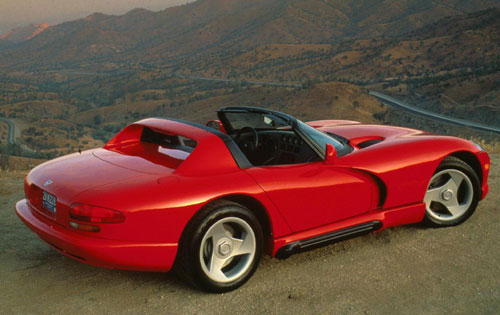
Gen I Viper RT/10
The original Viper RT/10 was a roadster that made due with no roof, no side windows, no exterior door handles, no traction control and no ABS. It was a basic, simple, no-frills sports car built around a huge, powerful engine just like the original Cobra. The Lamborghini built V10 produced 400HP/465TQ and launched the car from 0-60 in around 5 seconds with a 1/4 mile speed of 12.5. Top speed was around 180mph. The car's body was made of fiberglass over a tube steel chassis. Curb weight was 3280lbs. The only transmission available was a 6 speed manual. Production of this first generation Viper lasted from 1992 - 1995.

Gen II Viper GTS Coupe
The second generation Viper was introduced in 1996 with the introduction of a coupe, the Viper GTS. On the outside the second generation of Viper looks very much the same as the original but there were enough changes to classify it as a new generation. The engine was redesigned to provide more power and weigh less than the previous V10. The chassis was also redesigned and was not only 60lbs lighter but 25% stiffer. Suspension and brakes were also upgraded on the second generation Viper. The new V10 produced 450HP and the Viper could get to 60 in 4.2 seconds and through the 1/4 mile in 12.2. Top speed was now over 190mph. Dual airbags were now standard on the Viper but ABS was not available. Minor changes were made throughout the second generation's life span. 18" wheels were introduced in 1999, ABS in 2001. The V10's pistons were changed to hypereutectic from forged for weight savings at the sacrifice of some strength. The exhaust system on all models was improved and the side exhaust on the RT/10 roadsters was dropped in 1996.
In 2003 Dodge released a completely redesigned third generation Viper. The new car was designed by Chrysler's Street and Racing Technology group (SRT). The car was renamed the Viper SRT-10 and came in a roadster only body style. The all new body was not as wild looking as the original Viper's but was still a head turner. The V10 engine was increased to 8.3L and now produced 500HP/525TQ. The chassis was redesigned again and was lighter than the previous Viper's by about 80lbs. The Viper SRT-10 Coupe was introduced in 2005 at the Detroit Auto Show as a 2006 model. The design of the coupe was a combination of the original GTS and the SRT-10 Competition Coupe racing model. The coupe was a bit heavier that the convertible SRT-10 but the sleeker, more rigid body improved high speed performance and handling. Performance numbers for the third gen Vipers was a 0-60 of 3.9 seconds, 1/4 mile of 11.7 and a top speed of 196mph. No 2007 Vipers were sold as the 2006 model carried over to 2007 while Dodge prepared a revised Viper for 2008.

Gen III Viper SRT-10
2008 saw the Viper released with a revised 8.4L V10 with better flowing heads and larger valves. Cam in cam variable timing was introduced on the exhaust side and dual electric throttle bodies were added. Power was bumped up to 600HP/560TQ. The engine was mated to a new Tremec TR6060 6 speed manual with 18% quicker shifts than the T56 of the previous Vipers. Performance numbers of the fourth generation Viper are a 0-60 of 3.5 seconds, 1/4 mile of 11.5 and a top speed of 197mph for the roadster and 203mph for the coupe. The new car's weight increased to 3460lbs.

Viper SRT-10 Coupe
The Dodge Viper has been a classic example of the quintessential American sports car for the last 17 years. It combines brute power, outrageous looks, and minimal options to be one of the best performance bargains on the market. It is however, in jeopardy of being relegated to the history books. Chrysler has already announced that they will not be developing a replacement for the current model Viper. High gas prices, limited demand and Chrysler's woeful financial situation have conspired to threaten the existence of this amazing car. Chrysler is currently exploring the possibility of selling the Viper brand to another manufacturer. Hopefully they find a way to keep it around. It's an American classic.
Thursday, September 18, 2008
TRD engine Toyota Engine Development


TRD engine, have you heard about it, it is ana abreviation of Toyota Engine Development.all toyota team developed engine for sport car
With technology fed back from the racing field, TRD has improved the seal and durability of our cylinder head gaskets by changing the material and optimizing the surface pressure distribution. Also, by changing their thickness, we have made it possible to obtain the ideal compression ratio for improved performance.the result of the development shown on pictures
Singapore Grand Prix
 Formula singapore ticketing hotline +65 6738 6738
WILL BE FIGHT AT THE RACE
The 2008 FORMULA 1™ SingTel Singapore Grand Prix is a rain or shine event.come to visit the race. and the program are on the list below:
Program 1:
The provisional schedule of the race weekend is as follows:
Friday 26th September, 2008.
13.00 Gates open for all ticket holders
14.00 Formula One Paddock Club™, Sky and Club Suite Opens
15.00 – 15.25 Formula BMW Pacific Practice Session
15.50 – 16.20 Aston Martin Asia Cup Practice Session
16.40 – 17.25 Porsche Carrera Cup Asia Practice Session
17.50 – 18.15 Formula BMW Pacific Qualifying Session
19.00 – 20.30 Formula One First Practice Session
21.30 – 23.00 Formula One Second Practice Session
Midnight Formula One Paddock Club™ , Sky and Club Suite Closes
Saturday 27th September, 2008.
13.00 Gates open
14.00 Formula One Paddock Club™, Sky and Club Suite Opens
15.50 – 16.20 Aston Martin Asia Cup Qualifying Session
16.50 – 17.15 Formula BMW Pacific Race One (10 Laps)
17.45 – 18.15 Porsche Carrera Cup Asia Qualifying Session
19.00 – 20.00 Formula One Third Practice Session
22.00 – 23.00 Formula One Qualifying Session
Midnight Formula One Paddock Club™, Sky and Club Suite Closes
Sunday 28th September, 2008.
13.00 Gates open for all ticket holders
14.00 Formula One Paddock Club™, Sky and Club Suite Opens
15.30 – 16.00 Aston Martin Asia Cup Race (10 Laps)
16.30 – 17.00 Formula BMW Pacific Race Two (10 Laps)
17.30 – 18.05 Porsche Carrera Cup Asia Race (12 Laps)
18.30 Formula One Drivers Parade
18.45 – 19.15 Starting Grid presentation
19.46 Singapore National Anthem
20.00 2008 Formula 1™ SingTel Singapore Grand Prix (61 Laps)
Midnight Formula One Paddock Club™ , Sky and Club Suite Closes
Note: All information is correct as of 08/09/08 and is subject to change.
Subscribe to:
Posts (Atom)